
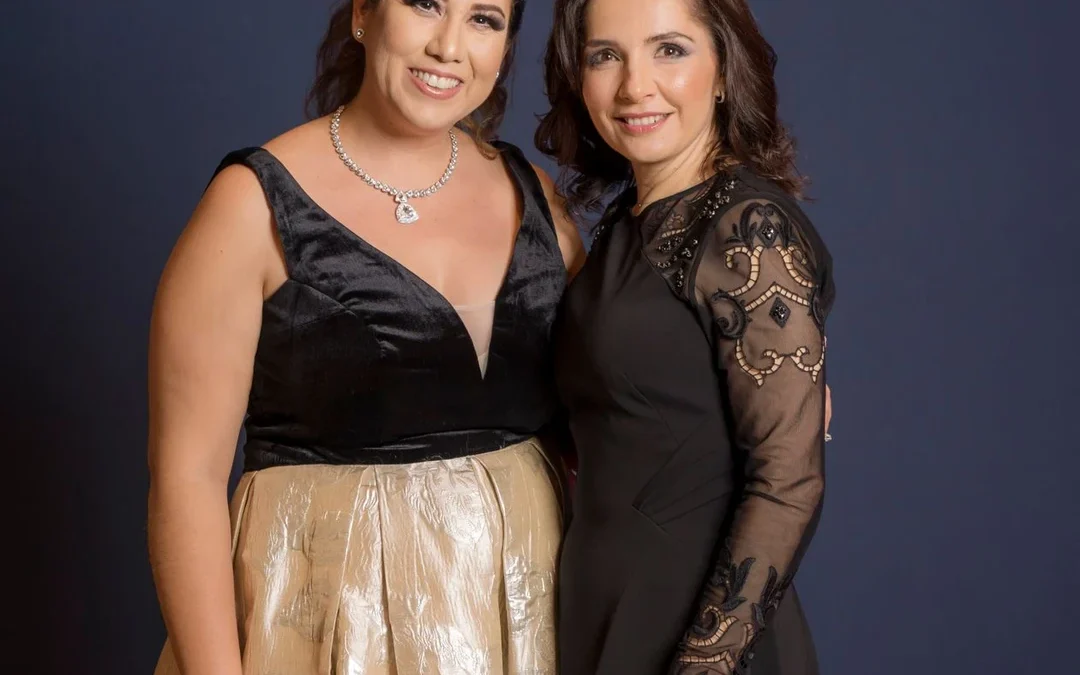
Your son is getting married, and somewhere between the seating chart and the rehearsal dinner, one question keeps coming back: what does the mother of the groom wear? The bride has a dress. The bridesmaids have dresses. The mother of the bride has — tradition says — already picked hers. And you, the groom’s mother, are supposed to look elegant, photographed, comfortable for ten hours, and somehow not like a bridesmaid, not like the bride, and not like you are trying to outshine anyone.
It is a narrower brief than it looks, and that is exactly why it is worth a guide of its own. Mother of the groom dresses are not just mother of the bride dresses with a different label. The role is different: you wait, you coordinate, you show up for two events instead of one, and you spend the whole day in the photographs next to the couple. This guide is built around that role — the groom’s-mother role decoder, the coordination rules that keep both mothers happy, and a 60-second comfort check you can run in your own living room before the dress ever leaves the house.
Every dress below is a real Amazon listing under $100, chosen for the things that actually matter on the day: a length that matches the dress code, sleeves or a jacket for coverage, a color that photographs well next to the wedding palette, and a fit that survives sitting, dancing, hugging, and a hundred photos. Prices were verified through the listing at publish time; if a price has moved since, the listing page is the authority.
As an Amazon Associate, Fashibly earns from qualifying purchases made through links on this page — at no extra cost to you.
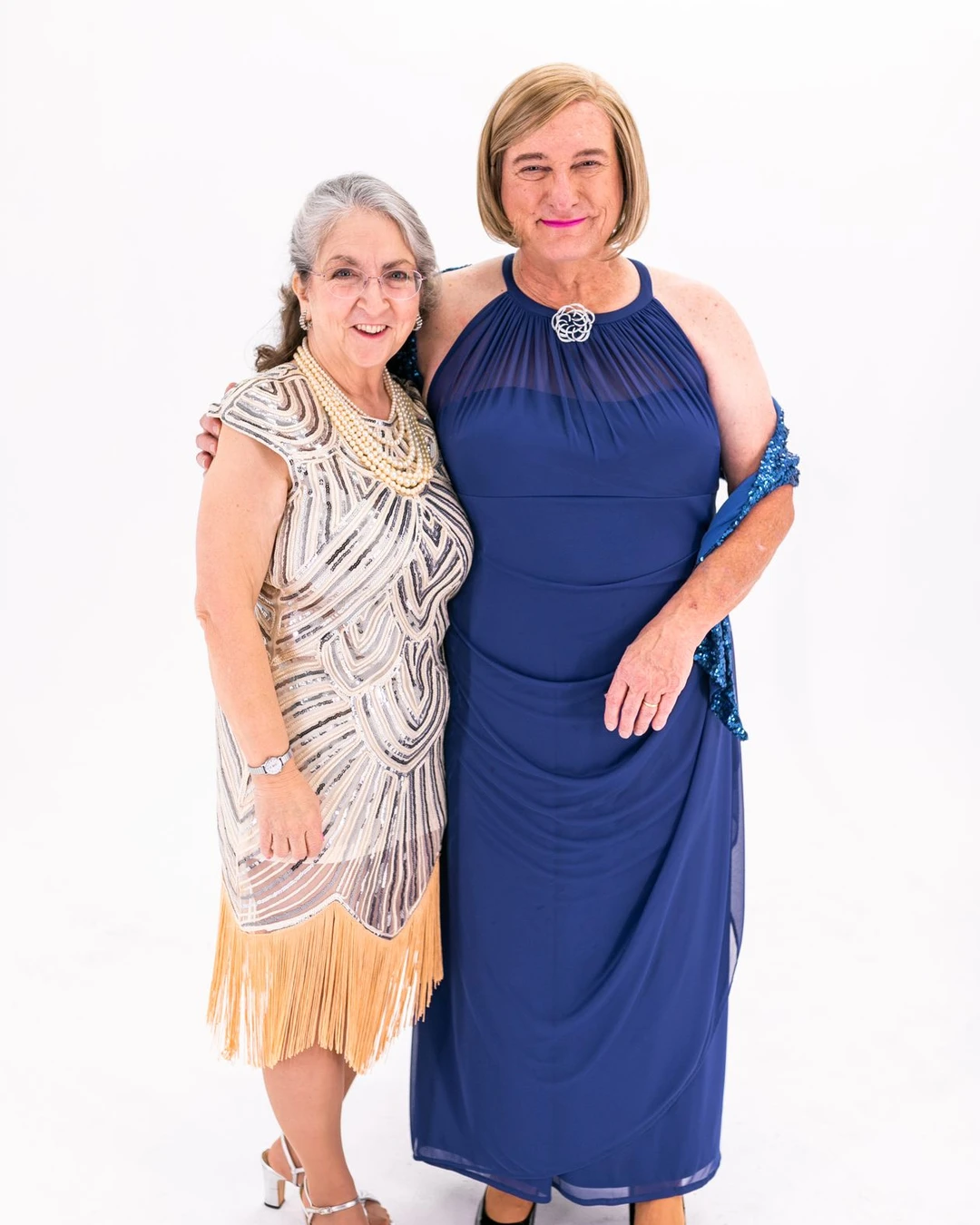
The groom’s-mother role decoder: how your dress differs from the bride’s mother’s
Start here, because this is the part most guides skip. The mother of the bride and the mother of the groom are not shopping for the same dress, even when they end up in the same color family. Three differences shape every choice below.
She picks first; you coordinate. Tradition — Emily Post, The Knot, and every etiquette guide we read — gives the mother of the bride first choice. She selects her dress, shares its color and level of formality, and then you choose something that harmonizes with it. That is not a demotion. It is a practical rule: two women in the same color, at the same formality, in the same family photographs, read as a matched set, and nobody wants that. The working version of the rule is simple: reach out to her early, ideally within a few months of the engagement, and compare notes on formality and color before either of you buys anything. Swap photos. If she is in dusty rose, a warm champagne or soft blush on your side creates a pairing that works beautifully alongside hers — but if she is in dusty rose and you are in dusty rose, you disappear into each other. Plum next to a deep navy works the same way: complementary, not matching.
You have two events, not one. The mother of the bride’s big day is the wedding. Yours is the wedding and the rehearsal dinner, and often a welcome brunch or a post-wedding lunch as well. That is why jacketed two-piece sets earn a whole group in this guide: a dress with a matching jacket is two looks in one. Jacket on for the ceremony and the formal photographs; jacket off at the rehearsal dinner, or the other way around. One dress, two events, no second purchase. If you are buying a single dress for the wedding alone, a long chiffon classic is the safer bet. If you are dressing for the whole weekend, start with the jacketed group.
You are in the couple’s photographs all day. The bride’s mother is photographed with the bride. You are photographed with the couple — walking your son down the aisle in many ceremonies, standing beside him in the family portraits, dancing with him at the reception. Your dress needs to hold up in photographs taken from every angle, in daylight and in flash, while you are moving. That is why this guide favors solid colors and mid-tone jewel shades over busy prints: solid colors photograph better than busy prints, and mid-tone and deep shades read richer in photos than pale pastels, which can wash out or — worse — read white in flash photography.
The 60-second comfort check: sit, dance, photos, hug
Before you keep any dress, run this check at home, in the shoes you will wear on the day. It takes a minute, and it catches almost every regret before the return window closes.
The sit test (15 seconds). Sit down in a chair the way you will sit through the ceremony and dinner. Does the waistband dig in? Does the skirt ride up past your knees when you are seated? Does anything pull across the shoulders? A dress that only works standing up is a dress you will be tugging at for ten hours.
The dance test (15 seconds). Take three steps in each direction and raise both arms to shoulder height, the way you will when you dance with your son. If the sleeves bind, the bodice shifts, or the skirt tangles around your legs, the dress is fighting you. Chiffon A-lines and empire waists pass this test more often than fitted sheaths, which is why most of the picks below are A-line.
The photo test (15 seconds). Stand in front of a mirror and take two photos with your phone — one with flash, one without. Check three things: does the color read the way you expected (pale shades can photograph white; that is a real risk, not a myth), does the fabric show every line underneath it, and does the neckline sit where you think it sits? What looks fine in a mirror can surprise you in a photograph.
The hug test (15 seconds). Hug someone. Seriously. You will hug your son, his new spouse, both sets of parents, and a receiving line of relatives. If the dress has a back zipper that gaps when you lean forward, a neckline that slides, or sleeves that ride up to your elbows, you will feel it in every single hug. A dress that passes the hug test is a dress you can forget you are wearing — and forgetting you are wearing it is the whole point.
The 8 dresses at a glance
| # | Dress | Best for | Price |
|---|---|---|---|
| 1 | Ever-Pretty chiffon V-neck, dusty blue | The ceremony classic | $84.99 |
| 2 | Ever-Pretty asymmetrical rhinestone midi, eucalyptus | The modern formal | $78.99 |
| 3 | Ever-Pretty Plus chiffon, sky blue | Plus-size ceremony | $71.89 |
| 4 | Ever-Pretty sequin chiffon maxi in burgundy, half sleeves | Evening sparkle | $92.99 |
| 5 | Ever-Pretty sequin chiffon maxi, black | The black-tie evening | $92.99 |
| 6 | Ever-Pretty asymmetrical rhinestone midi, orchid | The daytime formal | $78.99 |
| 7 | DRESSTELLS cocktail dress, navy | The daytime cocktail | $49.99 |
| 8 | petyoo tea-length two-piece with jacket, navy | The garden ceremony | $79.99 |
Group 1: Long chiffon classics for the ceremony
These are the dresses for the ceremony itself — the long, flowing, photograph-friendly gowns that match a formal or black-tie-optional invitation. Chiffon is the fabric that keeps coming up in every guide we read, for a practical reason: it drapes without clinging, it moves when you move, and it breathes through a long day in a way satin does not. Satin shows sweat; chiffon forgives it. Two picks in this group are long, and the third is a midi, all in the dusty-blue family of colors that sit beside a wedding palette rather than inside it.
1. Ever-Pretty Chiffon V-Neck in Dusty Blue

Price: $84.99
Dusty blue is the color every etiquette guide names first for the groom’s mother, and this is the most straightforward version of it: a chiffon A-line with a V-neck, ruched short sleeves, and a delicate applique at the waist. The V-neck is the detail that does the most work — it lengthens the neck and frames a necklace, which matters in photographs — and the A-line skirt flares gently from the waist, so you can walk down the aisle, sit through dinner, and dance without thinking about the dress.
Fit and length notes: Long length; the A-line cut gives room through the midsection and hips without looking boxy. The ruched short sleeves cover the upper arm, which is the coverage most readers ask for first.
Pros: The safest color in the guide; sleeves included; the waist applique gives definition without a belt. Cons: Verified at $84.99 at publish time, under the $100 cap. Short sleeves rather than 3/4, so bring a wrap for a cold church.
2. Ever-Pretty Asymmetrical Rhinestone Midi in Eucalyptus

Price: $78.99
Eucalyptus is the muted green that sits between sage and dusty blue, and it is one of the few colors that works next to almost any wedding palette without matching it. This midi pairs that color with an asymmetrical neckline and a rhinestone detail — the one-shoulder family of necklines that 2026 trend coverage keeps naming — over a flowing chiffon A-line skirt. It is the most modern dress in the ceremony group, and the one most likely to photograph as intentional rather than safe.
Fit and length notes: Midi length, as shown on the product card; the asymmetrical neckline means one shoulder is bare, so this is a dress for a warm venue or a wrap. The A-line skirt moves well; the rhinestone detail is at the neckline, not scattered across the bodice, so it reads as one considered detail rather than all-over sparkle.
Pros: A genuinely current neckline; the eucalyptus shade is hard to clash with; the rhinestone detail photographs beautifully in evening light. Cons: One bare shoulder means you need a wrap or jacket for the ceremony if the venue is cold or the dress code is conservative; the neckline is the least forgiving pick in the group for readers who want full coverage.
3. Ever-Pretty Plus Chiffon in Sky Blue

Price: $71.89
The plus-size pick in the ceremony group, and the one built most explicitly for curves: a floor-length chiffon A-line with short ruffle sleeves, a V-neckline, a back zipper, and a delicate applique at the waist. The listing describes it as designed for apple and pear shapes, with room through the midsection and hips — which is exactly what the sit test rewards. Sky blue is a lighter shade than dusty blue, so run the photo test with flash before the day: in bright light it stays clearly blue, but check it against your own skin tone and the wedding palette first.
Fit and length notes: Floor length; plus-size cut with an A-line silhouette. The ruffle sleeves are short, so the upper-arm coverage is light; the waist applique gives the waist definition that a straight chiffon column would not.
Pros: A real plus-size cut rather than a straight-size dress sized up; floor length for formal ceremonies; the V-neck and waist applique flatter without squeezing. Cons: Short ruffle sleeves are the lightest coverage in the group; sky blue is the palest shade in the guide, so the flash photo test is not optional.
Group 2: Sequin and shine for the evening — plus one daytime cocktail
Evening weddings, winter weddings, and black-tie-optional invitations are where sequin earns its place. The rule for sequin as the groom’s mother is the same as the rule for everything else: one considered detail, not head-to-toe glitter, and never more sparkle than the bride. The three sequin picks in this group keep the sequin in the bodice or the fabric weave rather than scattered across the whole dress, and all three are long or maxi, which keeps the shine formal rather than party. The fourth pick in the group is a daytime cocktail dress in navy, for the afternoon ceremony or rehearsal dinner where a floor-length sequin gown would be too much.
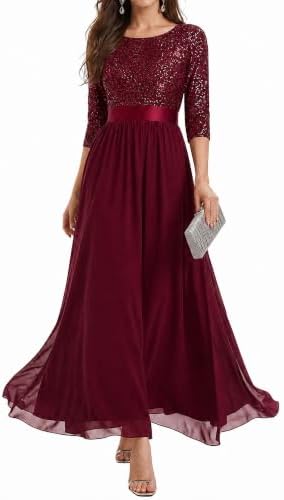
4. Ever-Pretty Sequin Chiffon Maxi in Burgundy, Half Sleeves
Price: $92.99
A sequin-and-chiffon A-line maxi with half sleeves in burgundy — the combination that shows up most often when you search for mother of the groom dresses, because it solves two problems at once: the sequin gives the evening formality, and the chiffon keeps the dress light enough to wear for hours. The half sleeves are the coverage detail that matters here: they cover the upper arm without the weight of a full sleeve, and they make the dress work in a cold ballroom as well as a warm one. The color shown on the product card is burgundy, a deep wine red with a sequin bodice.
Fit and length notes: Maxi length (59 inches shoulder to hem on the listing); A-line cut. The sequin is woven into the chiffon rather than glued on top, so it reads as shimmer rather than costume.
Pros: Half sleeves plus sequin is the most versatile evening combination in the guide; the A-line skirt dances well. Cons: Burgundy is an evening shade — save it for after 6pm rather than a daytime garden ceremony, and check it against the wedding palette first.
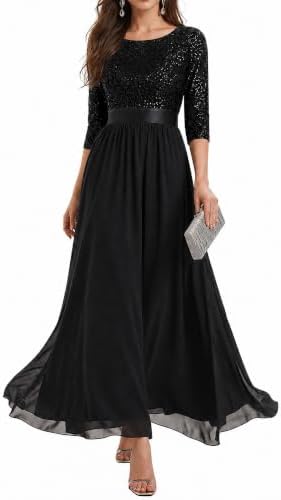
5. Ever-Pretty Sequin Chiffon Maxi in Black, Half Sleeves
Price: $92.99
The black version of the same sequin chiffon maxi, and the dress to reach for when the wedding is a formal evening affair. Black was once a faux pas for mothers; today it is widely accepted at formal, black-tie, and evening city weddings — with one condition that every guide repeats: check with the couple first. Some brides love the drama of a black-tie look; others picture a lighter palette. A quick question saves a week of worry, and the sequin in this dress is exactly what keeps black from reading somber: it catches the light in photographs and reads celebratory rather than mournful. The product card shows this variant in black, distinct from the burgundy card for pick 4.
Fit and length notes: Maxi length; half sleeves; A-line. The same cut as pick 4 in a different color — if you are choosing between the two, pick by the wedding palette and the time of day, not by the dress.
Pros: The most formal dress in the guide; sequin keeps black festive; half sleeves give coverage without bulk. Cons: Black needs the couple’s okay — do not skip that conversation. At a daytime or garden wedding, black will look too heavy; save it for after 6pm.
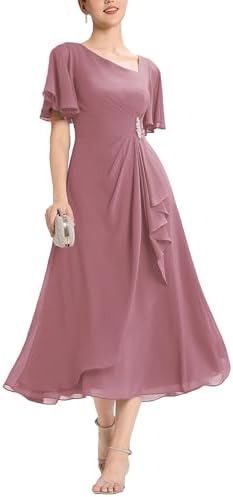
6. Ever-Pretty Asymmetrical Rhinestone Midi in Orchid
Price: $78.99
The daytime formal pick: the same asymmetrical rhinestone chiffon as pick 2, cut to midi length in orchid. Midi is the length the guides recommend for afternoon ceremonies, garden weddings, and daytime formals — long enough to read formal, short enough to walk on grass without the hem picking up the garden. Orchid is a muted purple that sits beside most wedding palettes without matching the bridesmaids, and it photographs well in daylight, where darker shades can go muddy.
Fit and length notes: Midi length; asymmetrical neckline with a rhinestone detail. The midi cut shows the shoe, so plan the heel with the dress rather than after it — a metallic or nude heel keeps the line long.
Pros: The right length for daytime and garden weddings; orchid is a genuinely uncommon MOG color, so matching the bridesmaids is unlikely; the rhinestone neckline photographs well in daylight. Cons: Asymmetrical neckline means one bare shoulder — a wrap for the ceremony is wise. Midi is the wrong length for a black-tie evening; do not force it there.
7. DRESSTELLS Cocktail Dress in Navy

Price: $49.99
The daytime cocktail pick, and the lowest-priced dress in the guide: a DRESSTELLS cocktail dress in navy, knee length, with cap sleeves, a shimmering bodice and a flared A-line skirt. It is listed as a formal wedding-guest dress rather than a mother-of-the-groom dress specifically, so treat it as the less formal option — the right choice for an afternoon ceremony, a garden wedding, or the rehearsal dinner, where a floor-length gown would be overdressed. Navy is the most requested color for mothers of the bride and groom, for the simple reason that it photographs beautifully in any season and clashes with almost nothing.
Fit and length notes: Knee length; A-line cut; cap sleeves. The knee-length hem shows the shoe and the leg, so a nude or metallic heel keeps the line long, and the fitted bodice means the waist fit is the part to check in the sit test.
Pros: The lowest price in the guide at $49.99; navy goes with any palette; the right length for daytime and for the rehearsal dinner. Cons: Knee length is the wrong length for a black-tie evening — do not force it there. Cap sleeves are light coverage, and as a wedding-guest listing it is not cut specifically for the mother-of-the-groom role, so check the formality with the couple first.
Group 3: Jacketed two-piece sets — one dress, two events
This is the group the MOB article could not finish — its jacket candidates all failed the price gate — and it is the group that matters most to the groom’s mother, because she is the one dressing for two events. A two-piece set with a matching jacket is two looks in one: jacket on for the ceremony and the formal photographs, jacket off at the rehearsal dinner or on the dance floor. The jacket also solves the arm-coverage question without a separate wrap, and it gives a cold church or a cold ballroom a built-in layer. Only one jacketed set in this guide survived the price gate — the other four candidates either showed no displayed price or were no longer available — so it carries the group on its own, and it is a good one.
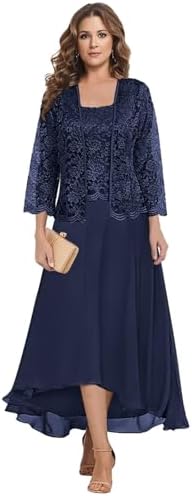
8. petyoo Tea-Length Two-Piece with Jacket in Navy
Price: $79.99
The garden-ceremony pick, and the only tea-length dress in the guide: a two-piece chiffon set with a matching jacket, in navy, cut to tea length. Tea length — mid-calf — is the length the guides call the ageless length, and it is the right answer for a daytime wedding, a garden ceremony, or a brunch reception, where a floor-length gown would drag on grass and look overdressed. Navy is the most requested color for mothers of the bride and groom, for the simple reason that it photographs beautifully in any season and clashes with almost nothing. The jacket gives the coverage, the tea length gives the ease, and the navy gives the photographs their anchor.
Fit and length notes: Tea length (mid-calf); the jacket is the coverage piece. Tea length shows the shoe and the ankle, so the heel matters more here than with any floor-length pick — a nude or metallic heel keeps the leg line long.
Pros: The right length for daytime and garden weddings; navy is the safest color in the guide; the jacket makes it formal enough for the ceremony. Cons: Tea length is the wrong length for a black-tie evening — do not force it there. Navy next to a navy bridesmaid color is the one matching risk in the guide; check the bridesmaids’ shade before you buy.
How we chose these 8 dresses
Every dress in this guide passed the same gate. First, it had to be a real Amazon listing with a displayed price under $100 — not a list price, not a coupon price, a price you can actually pay. Second, it had to have sleeves or a jacket: the groom’s mother spends the day in photographs, and bare shoulders are the detail most readers regret. Third, it had to be a color that coordinates rather than matches — no white, no ivory, no champagne, and nothing that reads as the bridesmaids’ exact shade. Fourth, it had to survive the logic of the 60-second comfort check: an A-line or empire cut that lets you sit, dance, and hug without adjusting.
We started from the brands that reliably stock this niche on Amazon — Ever-Pretty and DRESSTELLS older listings, plus the jacketed two-piece specialists — and we checked each listing against the mother of the bride guide we published earlier, so no dress in this guide repeats a pick from that article. Five of the twelve dresses we started with did not survive the gate: two were no longer available, and three showed no displayed price, so they were cut rather than published with a guessed price. Where a listing’s length or color was ambiguous in the fields we could read, the publish step verified it on the product card. Prices are verified at publish time; Amazon prices move, so the listing page is always the final word.
Shopping tips: coordination, color, venue, and timing
Coordinate with the bride’s mother first, buy second. This is the single most useful sentence in the guide. Text her before you buy anything. Share the color family and the formality level, not the exact dress — you are aiming for two women who look like they belong in the same photographs, not two women in a matched set. If she is in a long chiffon gown, you should be in a long chiffon gown, not a cocktail dress. If she is in dusty rose, you should be in a color that sits next to dusty rose — plum, navy, sage — not dusty rose itself. The photographs will thank you.
The color rules, in one paragraph. White, ivory, cream, and champagne belong to the bride — champagne is the one people get wrong, because it looks beige on a hanger and white in a flash photograph. The bridesmaids’ exact shade belongs to them; a color that sits next to theirs is fine, the same color is not. Black is acceptable at most modern formal and evening weddings, but ask the couple first. Bright red draws the eye in group photos and is the bride’s color at Chinese and many Hindu weddings, so ask first there too. Navy, dusty blue, plum, burgundy, sage, pewter, and deep teal are the shades that almost never cause a problem.
Match the length to the dress code, not to the other mother. Black tie means a floor-length gown. Formal evening means floor length or a sophisticated midi. A daytime or garden ceremony means tea length or midi. And if the invitation names no dress code at all, read it as formal — a floor-length gown or an elegant midi, not a sundress. The hour matters as much as the code: an afternoon ceremony takes a midi or tea length, and once the event starts after 6pm, move to floor length.
Order early enough for alterations. The guides disagree on the ideal window — six to nine months, four to six months, two to three months as Emily Post’s minimum — and they are all describing the same thing: order early, leave at least two weeks for alterations, and do not plan to buy the week of the wedding. Amazon’s fast shipping is a safety net for late shoppers, not a plan. Order two to three months out at the latest, try the dress on with the shoes and the undergarments you will wear, run the 60-second comfort check, and leave time for a hem.
The rehearsal dinner is a second outfit, not an afterthought. You will be photographed at the rehearsal dinner too, and you will be more relaxed there than at the wedding — which is exactly why the jacketed two-piece set in this guide earns its place. Jacket off, same dress, different look. If you buy a single long gown with no jacket, plan a second, simpler look for the rehearsal dinner — a midi dress or a dressy separates outfit in the same color family. Our cocktail attire wedding guest guide decodes the dress codes you will see on those invitations, and our what to wear to a wedding over 50 guide covers the same decisions for the guest side of the family.
Winter weddings need a layer plan. A November or December wedding means a cold church, a cold photograph session outdoors, and a warm ballroom — three temperatures in one day. That is why the jacketed group exists, and why our winter coats for women over 60 guide is worth a look for the coat that gets you from the car to the church without crushing the dress. Long sleeves, lined chiffon, and a jacket you can keep on for photographs are the winter answers; a bare-shoulder gown with no wrap is the winter mistake.
Frequently asked questions
What color should the mother of the groom wear?
A color that complements the wedding palette and the mother of the bride’s dress without matching either. Navy, champagne, sage, plum, silver grey, and burgundy are reliable choices, while white, ivory, and the bridesmaids’ exact shade are the only firm exclusions. The practical test is the photograph: stand next to the bride’s mother in your two dresses and check that you look coordinated, not cloned. If you are unsure about a color, ask the couple — they would rather answer the question than see the photographs later.
Should the mother of the groom match the mother of the bride?
No. The two mothers should coordinate rather than match. Aim for the same level of formality and a similar length so the family photographs feel balanced, but choose clearly different colors so neither mother appears to be copying the other. The traditional order is that the mother of the bride chooses first and shares her color and formality, and the mother of the groom then picks something that harmonizes with it. If you are shopping at the same time, compare notes before either of you buys.
Can the mother of the groom wear black?
Yes, at most modern weddings — black is widely accepted for formal, black-tie, and evening city weddings, and it photographs beautifully. The condition is that you check with the couple first, because some brides picture a lighter palette and some venues read black as somber in daylight. A black dress with sequin, lace, or a metallic detail reads celebratory rather than mournful, which is why the black pick in this guide carries sequin. Save black for after 6pm; at a daytime or garden wedding it will look too heavy.
How long should a mother of the groom dress be?
The dress code on the invitation sets the length. Black tie and formal evening call for a floor-length gown. A formal daytime ceremony suits a tea-length or midi dress. A garden, beach, or brunch wedding takes tea length or midi. The hour is the tiebreaker: afternoon means midi or tea length, and once the event starts after 6pm, move to floor length. Whatever you choose, match the mother of the bride’s length — if she is in a floor-length gown and you are in a knee-length dress, the photographs will look unbalanced.
How early should I order my mother of the groom dress?
Four to six months before the wedding is the comfortable window, and two to three months is Emily Post’s minimum — with at least two weeks left for alterations either way. The reason is not the dress, it is the coordination: you need the mother of the bride’s choice before you finalize yours, and you need time for a hem, a fitting, and the 60-second comfort check at home. Amazon’s fast shipping helps late shoppers, but alterations still need weeks, so do not plan to buy the week of the wedding.
What should the mother of the groom wear to the rehearsal dinner?
Something less formal than the wedding dress, in the same color family. The easiest answer is a jacketed two-piece set: wear the dress with the jacket for the ceremony and without it — or with a different top — for the rehearsal dinner, and you have two looks from one purchase. If you bought a single long gown, a midi dress or dressy separates in a coordinating color work for the rehearsal dinner. The rehearsal dinner is usually the more relaxed event, so a shorter hem and a simpler fabric are appropriate there in a way they would not be at the ceremony.
The bottom line
The mother of the groom’s dress is not a smaller version of the mother of the bride’s dress. It is a different job: wait for her choice, coordinate without matching, dress for two events, and hold up in the couple’s photographs for ten hours. The eight dresses in this guide are built for that job — long chiffon classics for the ceremony, sequin for the evening, a daytime cocktail, and a jacketed two-piece set that turns one purchase into two looks — all under $100, all with sleeves or a jacket, and all in colors that sit beside a wedding palette instead of inside it.
If you take one thing from this guide, take the order of operations: text the bride’s mother first, agree on formality and color family, order two to three months out, and run the 60-second comfort check — sit, dance, photos, hug — before the return window closes. Do that, and the dress stops being something to worry about and becomes what it should be: the thing you forget you are wearing while you watch your son get married.
For the other half of the family, our mother of the bride dresses under $100 guide covers the same ground from her side — the color-etiquette and venue-length decoder she is shopping from, with ten more dresses that do not repeat any pick in this guide.
1 response