
Business casual outfits for women are the most-searched style question in the working world for one simple reason: nobody can agree on what the words mean. Ask ten people and you will get ten answers. One swears it means a blazer and jeans. Another swears jeans are banned entirely. A third is quietly convinced her smartest hoodie qualifies. Meanwhile you are standing in front of your closet at 7 a.m., with a meeting at nine, wondering whether the outfit in your hands will read as polished or as a mistake.
Here is the truth the top guides all agree on, once you strip away the jargon: business casual is not a list of allowed clothes. It is a judgment call, and it is the hardest dress code precisely because it is a judgment, not a uniform. The good news is that the judgment can be learned. This guide decodes it — the formality ladder, the five outfit formulas that work in almost any office, the office-type rules for corporate, creative, hybrid, and casual-Friday workplaces, and a 60-second desk test you can run in front of your mirror before you leave the house.
And because decoding is only useful if you can actually wear it, the second half of this guide is a 12-piece capsule: 12 separate pieces from Amazon, every one under $50, that combine into 15+ outfits. Not 12 dresses. Twelve pieces — blazers, trousers, skirts, blouses, knits, loafers, and one blazer dress — that mix and match across a full working week and beyond. Every price below was checked through our price-verification step before publishing; anything that came back over $50, unavailable, or without a displayed price was cut and replaced, and the “How We Chose” section at the end says exactly what happened.
As an Amazon Associate I earn from qualifying purchases.
What Business Casual Actually Means for Women
Business casual means polished and professional without a matching suit. Think of it as “smart, put-together, and comfortable enough to sit through a long meeting.” Clothes should be clean, pressed, well-fitting, and free of loud logos, rips, or distressed finishes. The outfit should look intentional — like you could walk into a meeting you did not know about at nine in the morning and hold your own.
The quick test every serious guide lands on is the same: would this outfit look natural in a client meeting with someone you want to impress? If yes, it is business casual. If it looks like you are headed to brunch, the gym, or a night out, it is not. A blazer does not make an outfit business casual if the rest of it is gym wear, and a dress is not automatically business casual just because it is a dress — if it is very short, very sheer, or made for a party, it fails the test on its own.
The other test that matters just as much is the sit-all-day test: could you sit, walk, and work in this comfortably for a full day? Tailoring that looks perfect standing still and tortures you by 11 a.m. is not a work outfit. That is why this guide ends with a 60-second desk test instead of starting with a shopping list.
The Formality Ladder: Business Formal vs Business Casual vs Smart Casual vs Casual
Most confusion disappears once you see the four rungs as a ladder. Business casual sits one rung below business formal and one rung above smart casual. Here is how to read each rung — and what changes when you step between them.
| Dress code | What it looks like | Shoes | Where you see it |
|---|---|---|---|
| Business formal | A matching suit or matching set, sheath dress with a jacket | Closed-toe heels or polished flats | Law, finance, government, boardrooms |
| Business casual | Separates that coordinate: trousers with a blouse, a knit with a midi skirt, a sheath dress with a blazer | Loafers, pointed flats, low block heels | Most offices, client meetings, presentations |
| Smart casual | One polished piece + one relaxed piece: dark jeans with a blazer, a knit with tailored trousers | Loafers, clean leather sneakers, ankle boots | Creative offices, tech, dinners, after-work events |
| Casual | Anything neat: tees, everyday jeans, sneakers | Sneakers, sandals | Fridays, internal-only days, startups with no code |
Two rules make the ladder useful. First, when in doubt, step one rung up, not down. It is far easier to soften a structured outfit — roll the sleeves, lose the jacket — than to add polish you did not bring. Dress one step more formally than you expect for a first day or a first meeting. Second, your own office’s written guidance beats any general guide, including this one. Check the handbook, ask about denim and shoes specifically, and watch what senior colleagues wear to client meetings — not what people wear on a casual day. That is the real dress code.
Business casual and smart casual get confused constantly, and the difference is worth one paragraph because the plan for this article lists “smart casual women” as a sub-keyword. Business casual is office-ready: tailored pants or skirts with a refined top, muted colors, conservative shoes, blazer optional, tees and distressed denim out. Smart casual is the stylish cousin with more ease and personality: clean denim or chinos, elevated knits or blouses, a blazer or cardigan for structure, and room for tasteful color, pattern, and modern footwear. The shortest version, from one comparison guide: business casual says “I belong in a professional setting.” Smart casual says “I belong in a professional setting, and I have taste.” If an invitation or an office only says “casual,” read it as one notch down from whatever that office normally wears.
The 5 Outfit Formulas That Work in Almost Any Office
Formulas are what turn a small wardrobe into a working week. A formula is a repeatable combination, not a uniform: once you know that a blazer plus tailored trousers plus a simple top works for you, you can change the color, the fabric, or the shoes and still have an outfit. Build from the middle out — start with the bottom, add a top that sits well with it, then a layer for warmth and polish, then shoes. If any step feels uncomfortable or needs constant adjusting, change that piece, not the whole outfit.
Formula 1 — Blazer + tailored trousers + simple top. The most reliable business-casual outfit there is, and the best place to start. Choose trousers that sit at your natural waist and fall to the shoe without pooling, a top in a solid color or a quiet pattern, and a blazer that closes comfortably without pulling. Swap the top color or the blazer fabric for a different day and the formula still holds. Picks 1 + 3 + 7, or 1 + 4 + 8.
Formula 2 — Blazer + dress. A knee-length dress with a blazer gives you a complete outfit in two pieces. The dress should let you sit and walk without riding up or needing adjustment, and the blazer should be long enough to cover the waistline. This is the presentation-day formula — the blazer adds structure and can come off indoors if the room runs warm. Picks 1 + 12.
Formula 3 — Smart knit + tailored trousers + loafers. For offices that lean casual, a fine knit top with tailored trousers and loafers is polished without a blazer. Keep the knit smooth rather than chunky, the trousers tailored rather than jogger-style, and the shoes clean and closed-toe. Add a blazer on top for meetings and you are back at Formula 1. Picks 9 + 3 + 11, or 9 + 4 + 11.
Formula 4 — Midi skirt + blouse + low heels or flats. A midi skirt with a tucked-in blouse is the strongest alternative to trousers, especially in warmer weather. Check the skirt’s length when sitting, not just standing, and choose a blouse that stays tucked without billowing. A belt can define the waist, but it should not be needed to hold the outfit together. Picks 5 + 7 + 11, or 6 + 8 + 11.
Formula 5 — Cardigan + shell + ankle trousers. The cold-office formula, and the one November demands. A longline cardigan over a sleeveless shell or knit top, with ankle trousers, is a soft alternative to a blazer — and it is the layer you will actually keep on when the office is freezing at nine and boiling by lunch. Let the cardigan end at mid-thigh or just above the skirt’s hem so it does not cut the line awkwardly. Picks 10 + 8 + 3, or 10 + 7 + 4.
One more formula from the style guides is worth stealing even though it is not a pick: Structure + Softness + Polish. Every outfit needs one structured piece (blazer, tailored trousers, crisp shirt), one soft piece (fine knit, silk-feel blouse), and one polished finish (loafers, a slim belt, clean shoes). Take one away and the balance tips: all structure looks corporate, all softness looks weekend, and no polish looks unfinished.
The 12 Pieces at a Glance
Every piece below is a separate — a building block, not a finished outfit. That is the whole point: 12 pieces that combine into 15+ outfits (the capsule math is worked out after the picks). Prices were verified through our price-check step before publishing; see “How We Chose” for the honest gate record. Prices can change on Amazon, so treat the figures below as verified at publish time.
| # | Piece | Best for | Price |
|---|---|---|---|
| 1 | Cicy Bell open-front blazer (royal blue) | Formula 1 & 2 — the structure piece | $47.99 |
| 2 | COUXILY silk-feel button-down blouse (navy + cream leopard print) | Formulas 1, 4 & 5 — the patterned top | $27.99 |
| 3 | NIMIN high-waisted ankle pants (cream) | Formula 1, 3 & 5 — the everyday trouser | $32.99 |
| 4 | PRETTYGARDEN tapered ankle dress pants (dusty slate-blue) | Formula 1 & 5 — the sharpest trouser | $36.99 |
| 5 | BTFBM below-knee pencil skirt (royal blue) | Formula 4 — the classic skirt | $14.99 |
| 6 | Urban CoCo fishtail pencil midi skirt (dark navy) | Formula 4 — the midi with movement | $22.98 |
| 7 | Zeagoo satin button-down blouse (champagne) | Formulas 1, 2 & 4 — the softness piece | $26.97 |
| 8 | Flowyair chiffon V-neck blouse (dark green) | Formulas 1, 4 & 5 — the color piece | $25.99 |
| 9 | Zeagoo turtleneck sweater (burnt orange) | Formula 3 — the winter knit | $29.94 |
| 10 | Amazon Essentials open-front cardigan (dark charcoal) | Formula 5 — the cold-office layer | $15.80 |
| 11 | Freeberry leather loafers (black) | Every formula — the polished finish | $42.99 |
| 12 | Allegra K blazer dress (beige) | Formula 2 — the one-piece outfit | $42.99 |
The 12 Pieces, in Detail
Layers
1. Cicy Bell Open-Front Blazer (Royal Blue) — $47.99

The blazer is the single most useful piece in a business-casual wardrobe, and this open-front Cicy Bell is the one to start with — the open front means no button pulling across the bust, which is the most common blazer fit failure, and the long sleeves and lapel collar give it the structure that makes everything underneath it look intentional. Royal blue is the color call here: navy reads corporate, black reads funeral-adjacent on some skin tones, and royal blue reads confident without shouting. It pairs with every bottom in this capsule and all three blouses.
Pros: Open front eliminates button-gap issues; wrinkle-resistant fabric that survives a commute; lapel collar reads polished even over a knit. Cons: The 24-inch length on some colorways is shorter than a traditional blazer, so check the listed length for your size — it should cover your waistband when you sit. Fit note: Shoulder seams should end at your shoulder bone. If they droop past it, size down; if the jacket pulls when you cross your arms, size up. Wear it in: Formula 1 (with picks 3 + 7), Formula 2 (over pick 12), and over pick 9 on cold mornings.
10. Amazon Essentials Open-Front Cardigan (Dark Charcoal) — $15.80
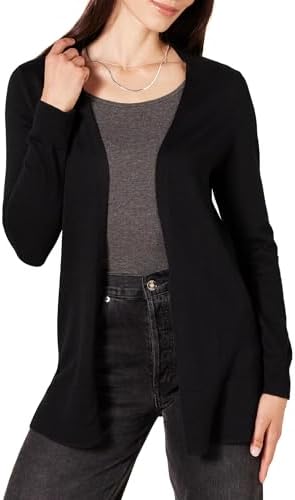
This is the cold-office insurance policy: a lightweight open-front cardigan in a cotton-modal-polyester blend that stays soft after washing, long enough (about 30 inches in a medium) to cover the waistband of the pencil skirts without cutting the line awkwardly. Dark charcoal is the right color — the card image reads nearly black, dark enough to look deliberate rather than loungewear, and it clashes with nothing. The open front layers over all three blouses and the turtleneck.
Pros: Lightweight enough for overheated offices, warm enough for freezing ones; cotton-modal-polyester blend that stays soft after washing; open front layers over blouses and the turtleneck; longer length covers the waistband of the pencil skirts. Cons: It will pill eventually like most open knits; a fabric comb handles it. Stick with the dark charcoal colorway — it is the one that reads as deliberate office wear rather than loungewear. Fit note: It hangs straight and long, so petite frames should check the length against their hip — if it hits mid-thigh it is doing its job; if it hits the knee, it is wearing you. Wear it in: Formula 5 (over picks 8 + 3), and as the third layer over Formula 3 on the coldest days.
Bottoms
3. NIMIN High-Waisted Straight Ankle Pants (Cream) — $32.99

If the capsule has one hardest-working piece, it is this one: a high-rise, straight-leg ankle pant in cream — a pale beige that is the capsule’s warm neutral — with pockets, offered in 26-, 28-, and 30-inch inseams. That inseam choice is the whole story — most ankle pants fail because the “ankle” lands mid-shin on tall women and mid-calf on petite women, and here you pick your length instead of gambling. The straight leg and high rise make it the default bottom for Formulas 1, 3, and 5, and it is the pair to buy first if you buy only one bottom from this list.
Pros: Three inseam lengths; high rise stays level when you sit; straight leg works with loafers and low heels alike; pockets. Cons: A straight ankle pant shows your shoe, so scuffed shoes show too — this is the pair that forces the shoe question. Fit note: The hem should graze the ankle bone. If it pools at the shoe, it is too long; if it shows half your shin, it is too short. Wear it in: Formula 1 (with picks 1 + 7), Formula 3 (with pick 9), Formula 5 (with picks 10 + 8).
4. PRETTYGARDEN Tapered Ankle Dress Pants (Dusty Slate-Blue) — $36.99

The tapered ankle pant is the sharpest trouser in the capsule — high-waisted, ankle length, flexible waistband, and a tapered leg in dusty slate-blue, a blue-grey that reads tailored rather than stretchy. Where the NIMIN pair is the everyday default, this is the meeting-day upgrade: the taper makes the silhouette cleaner under a blazer, and the ankle length keeps the look light with loafers or pointed flats. It is also the most forgiving of the two trousers for long desk days, because the flexible waistband does not dig when you sit.
Pros: Tapered leg looks sharpest under a blazer; flexible waistband for all-day sitting; ankle length elongates the leg with flats. Cons: The taper means less room in the calf — if you have athletic calves, check the measurements before ordering. Fit note: The waistband should sit flat without rolling when you sit; if it rolls, the size is wrong, not the pant. Wear it in: Formula 1 (with picks 1 + 8), Formula 5 (with picks 10 + 7).
Skirts
5. BTFBM Below-Knee Pencil Skirt (Royal Blue) — $14.99

A below-the-knee pencil skirt is the most conservative business-casual bottom there is, and this BTFBM version gets the details right: high waist, full elastic waistband, stretch bodycon fit, and a below-knee length that passes the sit test — the hem stays put when you sit instead of riding up. Royal blue is the capsule’s boldest color after the blazer, and it pairs with the champagne satin blouse, the dark green chiffon blouse, and the dark charcoal cardigan. The elastic waistband is the practical win: no zipper digging into your waist by 3 p.m.
Pros: Below-knee length is office-safe everywhere; elastic waistband + stretch means comfort without a belt; tummy-control shaping built in. Cons: Bodycon fit means the fabric shows lines under office lighting if your underlayers are not smooth — seamless underwear is not optional here. Fit note: The skirt should sit at your natural waist and end below the knee when you sit, not just when you stand. Check it seated. Wear it in: Formula 4 (with pick 7 + 11), and under the cardigan (pick 10) for cold offices.
6. Urban CoCo Fishtail Pencil Midi Skirt (Dark Navy) — $22.98
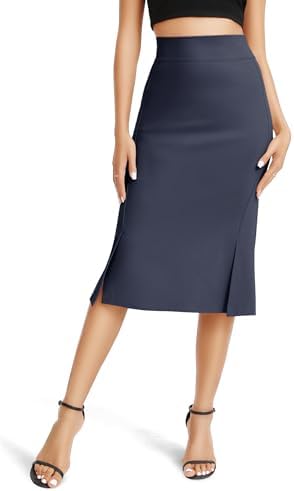
The second skirt in the capsule exists because one skirt is a uniform and two skirts are a wardrobe. This Urban CoCo midi has a fishtail hem and a back slit — the slit is the functional detail, because it is what lets you walk, climb stairs, and sit without the skirt fighting you. The viscose-polyester-spandex blend (63% viscose, 32% polyester, 5% spandex) has medium stretch, so it holds its shape through a full day instead of bagging out by lunch. In dark navy — a dark slate-blue, not black — it is one of the darkest bottoms in the capsule, which makes it the anchor for the champagne blouse and the cardigan.
Pros: The slit makes it genuinely walkable; medium-stretch fabric holds shape all day; midi length is the most forgiving hemline in the capsule. Cons: A fishtail hem reads slightly dressier than a straight pencil — it is better for presentation days than for the most casual offices. Fit note: High-rise waist should sit level; if the slit pulls open when you walk, the size is too small. Wear it in: Formula 4 (with pick 8 + 11), and with pick 9 tucked in for the winter version.
Tops
2. COUXILY Silk-Feel Button-Down Blouse (Navy + Cream Leopard Print) — $27.99

This is the capsule’s pattern piece: a long-sleeve, non-iron, wrinkle-free button-down blouse in a silk-feel fabric, printed in a navy and cream leopard pattern. The animal print is the quiet kind — small-scale, in two capsule colors — so it reads as personality rather than a statement, and it is the only patterned top in the capsule, which is exactly why it earns its place: it stops the solid colors from blending into one another. The wrinkle-free, non-iron finish is the practical win for a work blouse — it comes out of the wash ready to wear — and the long sleeves keep it office-appropriate on its own, with no layer required.
Pros: Wrinkle-free, non-iron fabric means no steaming before work; silk-feel drape looks more expensive than the price; navy and cream leopard print works with every bottom in the capsule; button-down front means adjustable coverage. Cons: A print blouse is harder to repeat invisibly than a solid — wear it once a week, not three times. Animal print is a matter of taste; if your office is strictly conservative, this is the piece to swap for a solid. Fit note: Button-downs should lie flat across the bust; if they gape, size up and tailor the waist, or wear a camisole underneath. Wear it in: Formula 1 (with picks 1 + 3), Formula 4 (with pick 6 + 11), and Formula 5 (with picks 10 + 3).
7. Zeagoo Satin Button-Down Blouse (Champagne) — $26.97

Every capsule needs one blouse that does the “softness” job in the Structure + Softness + Polish formula, and this Zeagoo satin button-down is it. The satin has a subtle sheen — not a shine — which is what keeps it office-appropriate instead of evening, and the 3/4 sleeves can be rolled for a more relaxed read. Champagne is the capsule’s light neutral: it warms up the royal blue blazer, softens the dark navy midi skirt, and disappears elegantly under the dark charcoal cardigan. The functional button placket lets you set your own neckline coverage, which matters for the desk test below.
Pros: Satin drape looks expensive without the price; 3/4 sleeves are the most versatile sleeve length in the capsule; button placket means adjustable coverage. Cons: Satin shows water spots and wrinkles more than cotton — keep a lint roller and a steamer nearby. The relaxed fit can billow if untucked; tuck it or half-tuck it. Fit note: Button-downs should lie flat across the bust; if they gape, size up and tailor the waist, or switch to the knit. Wear it in: Formula 1 (with picks 1 + 3), Formula 4 (with pick 5 + 11), Formula 5 (with picks 10 + 4).
8. Flowyair Chiffon V-Neck Blouse (Dark Green) — $25.99

This is the capsule’s color piece, and dark green is the right kind of color for business casual: deep, muted, and seasonal without being a trend that dates by spring. (Forest green is one of the strongest winter-2026 office colors.) The V-neck chiffon is lightweight and flowy, which makes it the blouse that survives overheated offices, and the long sleeves keep it office-appropriate on their own — no layer required. It is also the blouse that makes the cream ankle pants and the royal blue pencil skirt look deliberate instead of matchy.
Pros: Dark green is a true office color that still reads as personality; V-neck elongates the neck and frames a necklace; lightweight chiffon breathes in warm offices. Cons: Chiffon is sheer-adjacent in lighter colors — dark green avoids the problem, but check opacity in bright light. It needs a camisole underneath in some lighting. Fit note: The V should end above the bust line for work; if it dips lower, a camisole fixes it in ten seconds. Wear it in: Formula 1 (with picks 1 + 4), Formula 4 (with pick 6 + 11), Formula 5 (with picks 10 + 3).
Knits
9. Zeagoo Turtleneck Sweater (Burnt Orange) — $29.94

November is turtleneck season, and the fine-gauge turtleneck is the single most useful winter work top: it layers under a blazer without bunching, it replaces a blouse on casual-leaning days, and it is the only top in this capsule that genuinely keeps you warm on a cold commute. This Zeagoo version, in burnt orange — a rust-orange that is the capsule’s warmest color — has a side-split hem (no tugging when you sit), ribbed cuffs and hem, and a slim enough fit to tuck into high-waisted trousers without bulk. It is the top that makes Formula 3 work in winter.
Pros: Side-split hem sits flat when tucked; fine gauge layers cleanly under the blazer; ribbed cuffs keep sleeves out of your keyboard. Cons: A turtleneck is a commitment — if you run hot, this is the piece you will shed by lunch, so keep the cardigan nearby instead of a second knit. Fit note: The neck should sit close without choking; if you are constantly tugging it down, the size is wrong. Tuck it fully into high-waisted bottoms — a half-tuck looks accidental with a turtleneck. Wear it in: Formula 3 (with picks 3 + 11 or 4 + 11), and under the blazer (pick 1) for the warmest version of Formula 1.
Shoes
11. Freeberry Leather Loafers (Black) — $42.99

Shoes are where business casual is won or lost, and loafers are the answer for most offices: closed-toe, polished, walkable, and professional without a heel. These Freeberry loafers are pebbled leather with a memory-foam insole and arch support, a gold horsebit accent that lifts them above a plain flat, and a flexible rubber sole with traction grooves — the details that matter when you are on your feet between meetings. Black is the deliberate choice: black loafers finish every outfit in this capsule without competing with the royal blue blazer, the dark green blouse, or the leopard-print blouse.
Pros: Memory-foam insole + arch support for all-day wear; pebbled leather stretches to your foot with no break-in; horsebit accent reads dressy enough for client meetings. Cons: Pebbled leather scuffs show more than smooth leather — a quick wipe keeps them presentable. True-to-size fit means no sizing games, but wide feet should check the width. Fit note: Your heel should not slip when you walk, and your toes should have wiggle room — loafers that pinch at 9 a.m. will blister by 3 p.m. Wear it in: Every formula. That is the point.
One-piece
12. Allegra K Blazer Dress (Beige) — $42.99

The blazer dress is the capsule’s shortcut: a knee-length sheath in beige (khaki) with a notch V-neck and button-down front that reads as a full Formula 2 outfit in a single piece. It is the answer for the mornings when you have five minutes and a presentation at ten — one piece, loafers, done. The sleeveless cut means it needs the blazer or the cardigan in most offices (the sleeveless-dress rule: acceptable only with a layer within arm’s reach), which is exactly why it pairs with picks 1 and 10 instead of standing alone.
Pros: One piece, zero coordinating; button-down front + notch neck read tailored, not trendy; knee length is office-safe. Cons: Sleeveless means it is a two-piece outfit in practice, not one — budget the layer. The button front can gap across the bust; a small snap or a camisole fixes it. Fit note: The waist should sit at your natural waist without pulling at the buttons; if it pulls, size up. Wear it in: Formula 2 (with pick 1 for presentations, pick 10 for desk days), with pick 11 and nothing else to think about.

Capsule Math: 12 Pieces, 15+ Outfits
The promise of a capsule is not that you own less. It is that everything you own works with everything else. These 12 pieces share one palette — black, navy, royal blue, charcoal, beige, champagne, dark green — so any top meets any bottom and any layer finishes any combination. Here are 15 outfits from the 12 pieces, enough for three working weeks without a repeat. (The price gate ran on 2026-11-17: one pick was cut and replaced, and the 15 outfits below use the final 12 — see “How We Chose”.)
Week 1 — the classics
- Monday (meetings): Blazer (1) + satin blouse (7) + ankle pants (3) + loafers (11) — Formula 1.
- Tuesday (presentation): Blazer (1) + blazer dress (12) + loafers (11) — Formula 2.
- Wednesday (desk day): Turtleneck (9) + ankle pants (3) + loafers (11) — Formula 3.
- Thursday (warm office): Chiffon blouse (8) + pencil skirt (5) + loafers (11) — Formula 4.
- Friday (casual Friday, if your office allows it): Cardigan (10) + satin blouse (7) + tapered pants (4) + loafers (11) — Formula 5.
Week 2 — the swaps
- Blazer (1) + chiffon blouse (8) + tapered pants (4) + loafers (11).
- Cardigan (10) + chiffon blouse (8) + ankle pants (3) + loafers (11).
- Turtleneck (9) + midi skirt (6) + loafers (11).
- Satin blouse (7) + midi skirt (6) + cardigan (10) + loafers (11).
- Blazer (1) + turtleneck (9) + ankle pants (3) + loafers (11).
Week 3 — the stretch
- COUXILY blouse (2) + ankle pants (3) + blazer (1) + loafers (11).
- Satin blouse (7) + pencil skirt (5) + blazer (1) + loafers (11).
- Turtleneck (9) + tapered pants (4) + cardigan (10) + loafers (11).
- Blazer dress (12) + cardigan (10) + loafers (11).
- Chiffon blouse (8) + midi skirt (6) + blazer (1) + loafers (11).
That is 15 outfits from 12 pieces, and it is not the ceiling — swap the blouse in any outfit for the other blouse, or the trouser for the other trouser, and the count keeps climbing. The rule for adding a 13th piece later: it must work with at least three things you already own. A second pair of shoes — a low block heel for presentation days — is the most useful next buy, and our work-dresses-under-50 guide covers the dress side of the same wardrobe if you want one-piece days as well.
The 60-Second Desk Test: Sit, Stand, Reach, Walk
Every outfit in this guide should pass this test in front of your mirror before you leave the house. It takes one minute and it catches every problem that only shows up at work.
Sit (15 seconds). Sit in a chair the way you sit at your desk. Does the waistband dig or roll? Does the skirt ride up past your knee? Does the blouse pull open at the bust or ride up at the back? Does the blazer button pull into an X? If anything needs adjusting while seated, it will need adjusting all day — change the piece, not your posture.
Stand (10 seconds). Stand straight and look at the hem lines. Trouser hems should graze the shoe, not pool on it. Skirt hems should fall below the knee when standing. The blazer should cover your waistband. The cardigan should end at mid-thigh or just above the skirt hem, not cut the line in half.
Reach (15 seconds). Reach both arms overhead, then reach forward like you are grabbing a file from a high shelf. Does the blouse untuck? Does the turtleneck ride up? Does the blazer pull across the shoulders? Does the dress neckline gap when you lean forward? A small snap at a wrap crossover, a camisole under a V-neck, or a blazer that fits at the shoulders fixes most of these in seconds.
Walk (20 seconds). Walk across the room and back, then climb a step if you have one. Do the loafers slip at the heel? Does the pencil skirt’s slit let you stride, or do you shuffle? Does the ankle trouser pool at the shoe or catch under your heel? Do you hear squeaking, rustling, or jingling that a quiet office will amplify? Shoes that squeak on hard floors and bracelets that clatter on a desk are the two most common “looked great, sounded terrible” failures.
If an outfit passes all four, it is a work outfit. If it fails one, fix that one thing — a different size, a camisole, a hem, a shoe — before you decide the whole outfit is wrong. The test is also the fastest way to read a new office: wear your most polished version on day one, watch what senior colleagues wear to meetings, and calibrate from there.
Office-Type Rules: Corporate, Creative, Hybrid, and Casual Friday
Business casual is not one dress code. It is four, depending on where you work. Here is how the same 12 pieces calibrate for each.
Corporate (law, finance, consulting, government). Stay closest to business formal. Blazer on for meetings, trousers or pencil skirts only, blouses buttoned to the top button or with a camisole, loafers or low heels, no denim, no sneakers, no open toes. Your formulas: 1 and 2, every day. The royal blue blazer and the tapered pants are your workhorses here; the chiffon blouse’s dark green is as loud as the color gets.
Creative (media, advertising, design, tech). The code loosens one full rung. The turtleneck and the COUXILY leopard-print blouse lead, the cardigan replaces the blazer most days, and the blazer dress without a layer is defensible after lunch. Dark, clean jeans would pass here on some days — but this capsule has no jeans in it, because jeans are the one item where “check your handbook first” is not optional. Your formulas: 3, 4, and 5, with Formula 1 held for client days.
Hybrid (two days in, three days home). The top half matters most on camera days, and the bottom half matters most on office days. On video days, the satin blouse or the turtleneck plus the blazer reads polished on camera even with the cardigan off — and solid colors beat fine stripes, which can shimmer on camera. On office days, wear the full formula; the commute is the only part that changes. The capsule’s real hybrid win is that every piece works for both halves of the week.
Casual Friday. One rung down, not three. The cardigan formula, the knit formula, and the midi skirt with flats all qualify. What does not qualify just because it is Friday: leggings as pants, athletic wear, ripped or distressed denim, slogan tees, crop tops, flip-flops, and anything sheer without a layer. The rule from the etiquette guides is blunt and worth repeating: the one person who goes too far is the one who gets the policy changed for everyone else.
The office holiday party. November means the work holiday party is on the calendar, and it is the one office event where business casual steps half a rung up, not down. The blazer dress (pick 12) with the blazer, or the dark navy midi skirt (pick 6) with the champagne satin blouse (pick 7) and loafers, covers it — the satin’s sheen reads festive without reading party. Save the sequins for outside work.
What Not to Wear (and Why Each One Fails the Test)
- Leggings worn as pants. They fail the coverage test — no structure, no polish, no meeting-readiness.
- Athletic wear, hoodies, and gym sneakers. They fail the intentional test. The office is not the gym, even on a hybrid day.
- Ripped, distressed, or light-wash denim. Dark, clean, well-fitting jeans pass in many offices; ripped or faded ones do not, even on Fridays.
- Slogan tees, graphic tees, and crop tops. A tee under a blazer is a smart-casual move, not a business-casual one, and a crop top is neither.
- Very short hems, sheer fabrics without a layer, and deep necklines. They fail the sit test and the lean-forward test at the same time.
- Flip-flops, beach sandals, and sky-high stilettos. The first two fail the polish test; stilettos fail the walk test — if you cannot walk comfortably in them for a full day, they are not work shoes.
- Anything wrinkled, stained, pilled, or visibly worn out. Fit matters more than price, but condition matters more than either. A $20 blouse, pressed, beats a $200 blazer with a stain.
How We Chose
Every piece in this guide passed a real gate before it was published — and the gate is the same one we use for every Fashibly roundup. First, we researched the keyword and the audience intent: the top-ranking guides, the recurring reader questions, and the formulas that working women actually repeat. Then we searched Amazon for real listings in each category — blazers, trousers, skirts, blouses, knits, cardigans, loafers, and one blazer dress — and shortlisted pieces that fit the brief: separates that combine into formulas, office-appropriate coverage and fabrics, and a listed price under $50.
Then the price gate ran on 2026-11-17 (9:32–9:51 a.m. ET): each shortlisted product was checked through the Hostinger Affiliate Marketing Tools “Link Amazon product(s)” block, which shows the live displayed price for the listing. Twelve pieces were shortlisted; one was cut — the GRACE KARIN wide-leg pants (B0G39NMV4M) came back with no displayed price and “Product does not exist anymore” on three separate checks, and its spare variant (B0G39K86N3) failed the same way. Backup B1, the COUXILY silk-feel blouse (B0FDQ9R1RY, $27.99), was promoted in its place. Backups B2 (Kate Kasin pencil skirt, $29.99) and B3 (Yincro cardigan, $16.99) were checked and passed, but were not needed and remain held in reserve. The final 12 pieces run $14.99–$47.99 — $368.61 for the whole capsule — with no pick over the $50 cap. The colorways in the sections above were rewritten to match the Hostinger cards, which show each listing’s default variant. The comparison table and the pick sections above reflect the final list after that gate — the cut section was rewritten for the replacement, and the capsule math was renumbered to match.
What we never do: we never invent prices, ratings, review counts, or testing claims. No ratings or review counts are cited in this article, because they could not be verified at publish time — the price gate confirms title, price, and availability only. We do not claim to have worn, washed, or tested these pieces — the fit notes come from the listings’ own size and fabric information and from the fit guidance in the top style guides. Prices change on Amazon, so treat the figures here as verified at publish time and check the live listing before you buy.
Shopping Tips for Business Casual on a Budget
Buy the bottoms first. Trousers and skirts are the pieces that fail most often on fit, and they are the pieces every formula is built on. One great pair of ankle pants does more work than three average blouses.
Build around one base color, then one warm neutral. This capsule uses black/navy as the base and beige/camel as the warm neutral, with royal blue and dark green as accents. Any top meets any bottom on that rail — that is the whole trick.
Hem for the shoe you wear most. Ankle trousers need hemming for loafers or for heels, not both. Take the shoes to the tailor with the trousers — and check the NIMIN’s three inseam lengths first, because the right inseam may mean no hemming at all.
Check the listing’s color before you buy. Amazon product cards show the listing’s default color variant, and the color in the photo is not always the color in the cart. Read the color name on the card, not just the picture.
Steam, don’t iron, knits and satin. A handheld steamer is the cheapest business-casual upgrade there is — it is the difference between “wrinkled” and “pressed” on the two fabrics that wrinkle most.
Keep a desk drawer kit. A lint roller, a small snap or safety pin for gaping buttons, a camisole, and a spare pair of flats turn most outfit emergencies into thirty-second fixes.
Read the return window before you order. Fit is personal and listings vary by brand — a US 8 in one brand is not the same as a US 8 in another. Order your usual size and one size up when the listing’s size chart suggests it, and return the one that fails the desk test.
Frequently Asked Questions
What is business casual for women?
Business casual for women is a workplace dress code that combines tailored separates with relaxed pieces. Think trousers, chinos, or midi skirts with blouses, knits, or button-downs, plus an optional blazer and closed-toe flats, loafers, or low heels. It is less formal than a suit but more polished than weekend clothes. The safest test: would the outfit look intentional in a meeting with a client or a senior colleague, and could you sit, walk, and work in it comfortably for a full day?
Can you wear jeans for business casual?
Sometimes — it depends entirely on your office. Dark, clean, well-fitting jeans without rips are accepted in many modern offices, especially when paired with a blazer, a crisp blouse, and polished shoes. Conservative and client-facing workplaces often limit denim to Fridays or ban it altogether. Check your company policy before wearing jeans regularly, and if you are new, wait until you see what colleagues wear on a Monday before you debut them on a Friday. This capsule has no jeans in it for exactly that reason: trousers are the safe default everywhere.
Do I need a blazer for business casual?
No — but a blazer is the easiest way to make an outfit look intentional. A smart jacket, a structured cardigan, or a tailored overshirt can play the same role in a more casual office, as long as the whole outfit still looks polished. The rule of thumb: own one blazer that fits at the shoulders and closes without pulling, and wear it for client meetings, presentations, and your first week somewhere new. On ordinary desk days, the cardigan or the knit alone is enough.
Can you wear sneakers for business casual?
In smart-casual and many tech or creative offices, yes — minimal leather sneakers in white, black, or tan, without bright logos or athletic mesh, with everything else tailored. In law, finance, and client-facing roles, loafers, flats, or low heels are safer. Sneakers are the one item where the office type matters more than the shoe: if leadership wears them, you can; if they do not, do not be the first.
Is a sweater business casual?
Yes. Fine-gauge crewneck, V-neck, and turtleneck sweaters in wool, merino, or cashmere are business-casual staples, especially over a collared shirt or with tailored trousers. The line is the knit itself: fitted knits that sit neatly at the waist pass; chunky, stretched-out, or graphic sweaters read as weekend wear. A turtleneck under a blazer is one of the most reliable winter office outfits there is.
What should I wear to a business casual job interview?
Dress one level above the company’s everyday code. A blazer with matching or tonal trousers or a knee-length skirt, a plain shell or blouse, and closed-toe flats or low heels is a safe choice almost anywhere. Leave jeans and sneakers at home even if employees wear them, and keep jewelry and fragrance light. Try the whole outfit on the day before — including walking and sitting — and pack a lint roller. Our full interview decoder, with an industry ladder and a 60-second sit-and-stand-and-handshake test, is here: Job Interview Outfits for Women Under $50 That Pass the Hiring-Manager Test.
The Bottom Line
Business casual stops being confusing the moment you stop treating it as a list and start treating it as a judgment with a test. The formality ladder tells you which rung you are on. The five formulas tell you what to wear on each rung. The office-type rules tell you how far your office lets you slide. And the 60-second desk test — sit, stand, reach, walk — tells you whether the outfit you picked actually works for a full day at a desk.
The 12 pieces in this guide are the cheapest way to run that system: two layers, two bottoms, two skirts, three tops, one knit, one pair of loafers, and one blazer dress, all under $50 each, combining into 15+ outfits across three working weeks. Start with the ankle pants and the blazer, add the blouse and the loafers, and build from there — one piece at a time, each one earning its place by working with at least three things you already own.
For the rest of the work wardrobe: our work dresses guide covers the dresses-only side, our general work clothes roundup covers the wider closet, the over-50 separates system adapts the same formulas for a different decade, and the fall capsule wardrobe shows how 12 pieces stretch across a whole season. If winter layering is your real problem, the winter-specific version of this decoder is here.


6 responses