
Job interview outfits for women are the rare purchase where the stakes are higher than the price tag. You are not buying a dress. You are buying the first seven seconds of a hiring manager’s opinion of you — the seconds before you say a word, while they decide whether you look like someone who already belongs on their team. The good news is that those seven seconds do not require a designer budget. They require the right level of formality, the right colors, and a fit that lets you forget about your clothes entirely and focus on your answers. Every one of the 12 job interview outfits in this guide costs under $50 on Amazon, and every one was chosen for how it reads in a real interview room: sitting across a table, standing to shake hands, walking down a hallway, or framed from the chest up on a video call.
As an Amazon Associate I earn from qualifying purchases. Prices below were verified on November 16, 2026 and can change on Amazon — always check the listing before you buy.
The first 7 seconds: what the hiring manager actually reads
Research from Princeton found that people form first impressions in under 100 milliseconds — before you have said a single word. In an interview, that snap judgment is not about beauty or fashion sense. It is about whether your outfit creates “cognitive noise”: anything that makes the interviewer notice your clothes instead of listening to you. A wrinkled blazer, a hem that rides up when you sit, a shoe you cannot walk in — each one is a small distraction that adds up to a gut feeling the interviewer cannot quite name.
The fix is not to dress expensively. It is to dress one notch above the job you are interviewing for, in clothes that fit so well you forget you are wearing them. That is the whole strategy of this guide. We will decode the dress code first, then give you the pieces.
The industry ladder: one outfit does not fit every interview
The single biggest mistake women make with interview outfits is applying one-size-fits-all thinking. “Business professional” at a law firm is completely different from “professional” at a fourteen-person startup. Before you pick anything, spend ten minutes on the company’s website and LinkedIn photos to find the baseline — how the team dresses on an ordinary Tuesday — then dress exactly one level above it. If you cannot tell, ask the recruiter; there is no penalty for asking.
| Where you are interviewing | What to wear | Dress code |
|---|---|---|
| Corporate: law, finance, consulting, government, senior roles | A matched or coordinated suit, or a sheath dress with a blazer; closed-toe shoes | Business professional |
| Most offices: marketing, HR, admin, corporate general | Tailored trousers or a knee-length skirt with a polished top and a blazer | Business casual plus a blazer |
| Tech, startups, agencies | Dark tailored trousers or a midi dress, a structured blazer, clean flats or loafers | Smart casual |
| Creative: design, media, advertising, fashion | Tailored trousers or a dress with one considered detail — a strong color, an interesting blazer | Smart casual with personality |
| Healthcare, admin and management | A blazer with tailored trousers or a knee-length pencil skirt; clean, no perfume | Business casual |
| Retail, hospitality, service management | A blazer over a fitted top with tailored trousers; clean flats | Neat casual, one step up from the uniform |
| Remote video, first round | A solid-color blazer and blouse that photograph well from the chest up; dress fully from the waist up | Business casual on camera |
Two things hold everywhere. First, trousers are completely standard — there is no residual expectation of a skirt in any industry worth working in, and if you are more comfortable in trousers, wear trousers and own it. Second, overdressing can hurt you in the wrong room: a full suit at a startup can signal that you do not understand the culture. One notch above, not three.
Color rules: navy vs black vs charcoal
Navy is the classic interview color because it looks calm and capable without the severity of head-to-toe black. Black, charcoal, and white are equally safe as foundations. The rule that trips people up is the all-black outfit: head-to-toe black is the most common interview choice, and it is also the one that most often reads as a funeral rather than a job interview. If you wear black, break it up — a white or light-blue blouse under a black blazer, a navy trouser with a black top, or a single warm accent like a burgundy blouse or a camel layer. Muted colors work as that accent: dusty rose, slate blue, burgundy. Avoid neon, bright red, and anything that demands attention more than you do.
For November and winter interviews, the same rules hold with heavier fabrics: wool, tweed, and structured knits. Your coat is part of the outfit — a hiring manager sees it in the lobby first — so it should be clean, dark, and simple.
The 60-second sit-and-stand-and-handshake test
Before any outfit leaves the house, run this test in front of a mirror. It takes sixty seconds and it catches nearly every interview outfit failure.
- Sit. Sit the way you will sit across a table. Does the skirt ride up? Does the blouse gap? Does the waistband dig in? Anything that needs adjusting while seated will need adjusting all through the interview.
- Stand. Stand up without tugging at anything. The hem should fall back into place on its own.
- Walk. Walk across the room at a normal pace without thinking about your feet. If you can hear yourself clacking down the hall, that is a distraction.
- Shake hands. Reach forward and shake an imaginary hand. Do the sleeves pull back too far? Does the blouse pull across the chest?
- Raise your arms. Lift both arms as if reaching for a file on a shelf. Check for visible bra straps and a top that rides up.
If an outfit passes all five, you can forget about it — and forgetting about your outfit is the entire point.
Comparison table: 12 job interview outfits under $50
Prices were verified at publish time (November 16, 2026) via the Hostinger Affiliate Marketing Tools price check. One pick — the navy Cicy Bell blazer at $58.99 — was cut for going over the $50 cap and replaced with the dark-khaki Cicy Bell blazer at $47.48; every pick below shows its verified price. A note on colors: the buy cards show each listing’s default colorway, so where the card shows white, teal, purple, or khaki, the section describes that exact colorway.
| Pick | Piece | Best for | Price |
|---|---|---|---|
| 1 | Cicy Bell One-Button Blazer, Dark Khaki (B0D1767GHX) | Corporate + every industry | $47.48 |
| 2 | GRACE KARIN Cropped Open-Front Blazer, White (B08D996R9G) | Business casual, layering | $38.99 |
| 3 | GRACE KARIN V-Neck Sheath Dress, Teal, 3/4 Sleeve (B0DNZFYGF5) | The one-and-done dress | $46.99 |
| 4 | GRACE KARIN Ruched Sheath Dress, Purple, 3/4 Sleeve (B0F9VCBP81) | Business casual, curvy-friendly | $43.69 |
| 5 | Amazon Essentials Straight-Leg Chino Trousers, Khaki (B08JDKVDJV) | The trousers default | $19.75 |
| 6 | Yogipace Petite Straight-Leg Dress Pants, 27″ (B08HTXLRML) | Petite frames, ankle length | $40.99 |
| 7 | Zeagoo Wrinkle-Free White Button-Down (B0FH6WH55W) | The white shirt that behaves | $14.99 |
| 8 | Zeagoo Sleeveless Button-Down Shell, Black (B073345HX6) | Under-blazer layer | $9.99 |
| 9 | Kate Kasin Knee-Length Pencil Skirt (B0789F9ZW8) | The skirt option | $29.99 |
| 10 | GRACE KARIN Long-Sleeve Henly Sheath Midi (B0F638GPLX) | Winter interviews | $36.98 |
| 11 | DREAM PAIRS Slingback Pointed-Toe Flats (B0DR8K1YM1) | All-day comfort | $35.99 |
| 12 | DREAM PAIRS Kitten Slingback Block-Heel Pumps (B0FDKKT44X) | A little height, safely | $37.99 |
The blazers: the highest-leverage piece you own
A blazer is the single highest-leverage piece in an interview wardrobe. It signals “I mean business” instantly, turns a dress into an interview outfit, and moves you one notch up the formality ladder without a whole new outfit. Fit matters more than formality: shoulders at the shoulder joint, no pulling across the chest, sleeves at the wrist. A cheap well-fitted blazer beats an expensive ill-fitting one every time.
1. Cicy Bell One-Button Blazer in Dark Khaki — $47.48
This is the blazer to buy first if you own no interview blazer at all: a single-button blazer with a notch lapel and flap pockets, in dark khaki — a warm neutral that reads polished without the severity of head-to-toe black, and pairs with both the navy petite trousers (pick 6) and the white button-down (pick 7). Wear it over the white button-down (pick 7) and the navy trousers (pick 6) for the corporate standard, or over the V-neck sheath dress (pick 3) for the one-and-done dress with more structure. (The navy version of this same blazer was cut from this guide: its verified price was $58.99, over our $50 cap.)
Pros: Khaki reads confident without being aggressive; one-button closure keeps the line clean; flap pockets add a traditional tailored detail. Cons: The slim fit means you should size up if you plan to layer a thick knit underneath in winter; check the sleeve length against your wrist before interview day. Fit note: Shoulders sit at the shoulder joint on a regular fit; if the body pulls across the chest when buttoned, size up and wear it open — an open blazer over a shell still reads as interview-ready.

2. GRACE KARIN Cropped Open-Front Blazer in White — $38.99
Not every interview needs a structured suit jacket. For business-casual offices, startups, and creative roles, this cropped open-front blazer in a cotton blend is the softer option: 95% cotton with a little elastane, three-quarter sleeves, and an open front that layers over a shell or a blouse without adding bulk. The card shows the white colorway — white over a dark shell or trousers is a clean, high-contrast interview look, and it photographs especially well on video calls. It is the blazer for the interview where a full suit would be overdressed — it says polished without saying boardroom.
Pros: Lightweight cotton knit moves with you through a long sit; three-quarter sleeves show a watch or bracelet neatly; the cropped cut works with high-waisted trousers. Cons: Open-front means no button to close — wear it over a shell with a clean neckline, never over a low top. Fit note: The cropped length ends at the hip; pair it with a tucked-in top.

The dresses: one-and-done interview outfits
A sheath dress is the fastest interview outfit there is: one piece, no matching, no tucking decisions. The rules are simple — knee length or midi, a neckline that stays modest when you sit and reach, sleeves or a blazer over a sleeveless cut, and a fabric with enough structure that it does not cling or wrinkle when you sit down. Our cocktail attire wedding guest guide uses the same decoder approach for a different room, and the fit tests transfer directly.
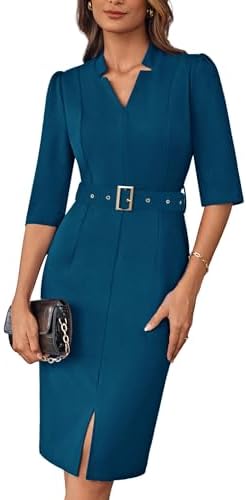
3. GRACE KARIN V-Neck Sheath Dress in Teal, 3/4 Sleeve — $46.99
This is the one-and-done pick: a V-neck sheath dress with three-quarter sleeves, a back zipper, and a belt, in teal — a muted jewel tone that works as the outfit’s single accent color under a neutral blazer. The three-quarter sleeve is the detail that makes it interview-smart — it covers the upper arm, sits neatly under a blazer without bunching at the wrist, and looks finished on its own if the room is warmer than expected. Wear it alone for a business-casual office, or add the Cicy Bell blazer (pick 1) for a corporate room.
Pros: The belt defines the waist without a separate accessory; the sheath cut is modest and structured; the V-neck frames the face without showing too much. Cons: Bodycon-leaning sheaths need the sit test more than any other piece — sit in front of a mirror and check the hem and the zip before you commit. Fit note: Knee length on most frames; if you are petite, check where the hem lands seated, and consider the petite blazer fit notes in our petite blazers guide for the layer on top.
4. GRACE KARIN Ruched Sheath Dress in Purple, 3/4 Sleeve — $43.69
Ruching is the most forgiving detail a sheath dress can have: it smooths the midsection, adds visual texture without a print, and makes the dress comfortable through a long panel interview. This crew-neck version with three-quarter sleeves is the curvy-friendly alternative to the V-neck above — same knee length, same office-ready cut, a quieter neckline. In muted purple it is the dress to reach for when you want one quiet accent color: keep the rest of the outfit neutral — the khaki blazer (pick 1), black shoes — so the dress is the only color doing the talking.
Pros: Ruched front flatters without clinging; crew neckline is the most modest option in this guide; hidden back zip keeps the line clean. Cons: Purple is an accent, not a neutral — in a very conservative industry, wear it under the khaki blazer (pick 1) so only a hint of color shows. Fit note: The ruching gathers at the waist, so the dress is more forgiving across sizes than a flat sheath; still run the sit test, since ruching can pull when seated if the size is too small.

10. GRACE KARIN Long-Sleeve Henly Sheath Midi Dress — $36.98
November interviews happen in cold buildings and colder commutes, and this is the winter pick: a long-sleeve midi sheath with a Henly V-neck, a hidden back zip, and a center back slit for walking. The below-knee length is the most conservative hem in this guide, which is exactly right for a winter interview at a formal employer — and the long sleeves mean you do not need a blazer to feel covered, though one still sharpens the outfit. Wear it with the low block-heel pumps (pick 12) and a dark coat over the top.
Pros: Long sleeves plus midi length equals full coverage with no layering decisions; the back slit keeps the narrow skirt walkable; the Henly neckline is refined without being fussy. Cons: A midi sheath plus a coat plus a blazer can feel like a lot of layers — choose the blazer or the coat as your outer layer, not both indoors. Fit note: The hips-wrapped silhouette contours closely; size for the hip, not the waist, and let the back slit do its job when you walk.

The trousers: pants are a complete interview answer
Trousers are completely standard everywhere, and there is no residual expectation of a skirt in any industry worth working in. What matters is the cut: straight-leg or ankle-length, a clean waistband, no wrinkles, no logos, no cargo details. Both trouser picks here are straight-leg — the universally flattering interview cut, clean over a flat or a low heel, intentional with a blazer.
5. Amazon Essentials Straight-Leg Chino Trousers in Khaki — $19.75
The default trousers. A slim-fit, straight-leg, mid-rise chino in a stretch twill, in khaki — the pair to buy when you need one trouser that works with every top in this guide. Amazon Essentials is the house brand that exists to be the reliable, inexpensive version of a wardrobe staple, and these trousers are exactly that: a clean straight leg, a work-pant cut, and a price that leaves room in the budget for the blazer on top.
Pros: The stretch twill moves when you sit and stand; the straight leg works with flats and low heels alike; khaki pairs with the white button-down and every blouse and blazer here. Cons: A chino reads slightly less formal than a true dress trouser, so for a law firm or finance interview, pair them with the structured blazer (pick 1). Fit note: Mid-rise, classic fit; if you are between sizes, size up — a waistband that digs in will distract you all interview.

6. Yogipace Petite Straight-Leg Dress Pants, 27-Inch Inseam — $40.99
Petite readers get the worst deal in interview shopping: a regular “ankle length” trouser pools at the ankle, and a regular knee-length skirt lands below the knee. These Yogipace dress pants fix the length problem at the source with a 27-inch inseam, four pockets, and belt loops, in navy. They are yoga-pant stretch in construction — which is the honest con, below — but cut as straight-leg dress slacks, so with a blazer on top they read as trousers, not leggings.
Pros: The 27-inch inseam means no hemming for most petite frames; four pockets hold a phone and keys; navy pairs with the white button-down and the khaki blazer (pick 1) for a classic two-tone suit effect. Cons: The stretch fabric feels like yoga pants, so this is a blazer-on-top pick — without the blazer it can read too casual for a formal room. Fit note: Petite sizing is about inseam, not waist; take your usual waist size and let the 27-inch length do the work.

The tops: what goes under the blazer
The top under your blazer does quiet work. White and light blue are the most universally flattering interview choices, and they photograph well on video calls too. The rules: solid colors or very subtle patterns, a clean neckline, nothing sheer, nothing that competes with your blazer. A sleeveless shell is the classic choice under a suit — but it stays under the blazer in the interview room.
7. Zeagoo Wrinkle-Free White Button-Down — $14.99
The white shirt is the interview staple that most often fails on the day — it wrinkles in the car, it goes sheer under office lights, it gaps at the buttons. This Zeagoo button-down is the wrinkle-free answer: a long-sleeve collared blouse in white, with a listing that names “Business Work Office Interview” as an occasion outright. White under a blazer is the highest-contrast, most polished combination in this guide, and it is the top to wear when the interview is on video, where a solid light color reads cleanly on camera.
Pros: Wrinkle-free fabric survives the commute; the collared neckline looks finished with or without a blazer; white brightens the face on a video call. Cons: White shows every mark — check for deodorant marks on dark blazers and for coffee before you leave; wear a camisole underneath if there is any doubt about sheerness. Fit note: The cut is a regular fit; tuck it in fully and check the buttons seated — if they gap, size up and have the waist taken in, or wear a shell underneath.

8. Zeagoo Sleeveless Button-Down Shell in Black — $9.99
The shell is the layer that makes a blazer outfit work: a sleeveless V-neck button-down in black that disappears under a jacket and keeps the outfit clean. It is also the most versatile piece in this guide — under the khaki blazer (pick 1) for corporate, under the open-front blazer for business casual, tucked into the pencil skirt (pick 9) for the skirt suit effect. The rule is simple: a shell is worn under a blazer in the interview room, never on its own.
Pros: The V-neck frames the face and leaves room for a simple necklace; sleeveless means no bunching under a blazer sleeve; black anchors any color combination. Cons: Sleeveless on its own is too bare for most interview rooms — if the blazer comes off, you need a cardigan or a jacket back on. Fit note: The V-neck should sit high enough that you never think about it; if it feels low, layer a camisole underneath or choose the white button-down instead.

The skirt: one good pencil skirt is enough
A knee-length pencil skirt is a classic interview choice. The rule for length is simple: no shorter than two inches above the knee while standing, and it must pass the sit test — nothing rides up when you sit, so you can cross your legs, shift in your chair, and stand without adjusting. If you prefer trousers, skip this section; the skirt is an option, not a requirement.
9. Kate Kasin Knee-Length Pencil Skirt in Black — $29.99
This is the skirt to buy if you want one. A knee-length pencil skirt with a back zipper and a side slit, in black, from the brand our own petite pencil skirts guide already relies on for work skirts — and the listing’s own occasion list literally includes “Interview”. The side slit is the practical detail: it lets you walk without the skirt pulling, and it keeps the narrow cut comfortable through a long sit. Pair it with the white button-down (pick 7) and the khaki blazer (pick 1) for the classic skirt suit, or with the sleeveless shell (pick 8) and the open-front blazer (pick 2) for business casual.
Pros: True knee length on most frames; the side slit means you can walk at a normal pace; the stretch fabric keeps it comfortable all workday. Cons: A pencil skirt demands the sit test more than trousers do — if the slit rides up when seated, the skirt is too tight, not too short. Fit note: The skirt is hip-wrapped and stretchy, so take your hip measurement seriously; a waistband that gaps when you sit is a sign to size down or add a belt.

The shoes: closed-toe, comfortable, forgettable
Your shoes communicate more than you would expect. Scuffed, worn-down heels read as careless, and shoes that hurt send a signal through your posture and your walk. You do not need stilettos. A low to mid heel of one to three inches in a neutral color is perfect, and flats are completely acceptable at every level of seniority — the priority is that you can move comfortably across lobby floors, up stairs, and on a walking tour if one happens.
11. DREAM PAIRS Slingback Pointed-Toe Flats — $35.99
The flats pick. A pointed-toe slingback ballet flat with a buckle strap and a low heel, in black — the flat that reads as intentional rather than underdressed, because the pointed toe and the buckle give it structure. Flats are the right call for a creative or casual interview, for a role that involves a facility tour, and for anyone who simply walks better in flats. Clean, closed-toe, polished: that is the whole brief.
Pros: The pointed toe elevates a flat into a dress shoe; the slingback strap keeps the shoe secure while walking; black works with every outfit in this guide. Cons: A slingback strap can slip if the fit is loose — try them with the socks or stockings you will wear on the day. Fit note: DREAM PAIRS runs true to size in our experience with the brand across Fashibly guides; if you are between sizes, size up for a long day on your feet.

12. DREAM PAIRS Kitten Slingback Low Block-Heel Pumps — $37.99
The low-heel pick. A pointed closed-toe pump with a 1.1-inch block heel and an adjustable slingback strap, in black — the heel that gives you height and polish without the wobble. The block heel is the key detail: it is far more stable than a stiletto on lobby floors and stairs, and the adjustable strap means the shoe stays put through a long day of sitting, standing, and walking between interview rooms.
Pros: The 1.1-inch block heel is the sweet spot between flat and heel; the adjustable strap gives a secure, custom fit; the pointed closed toe reads as formal. Cons: Even a low heel needs a test walk — wear them around the house for an hour before interview day, not for the first time on the morning of. Fit note: The strap adjusts, so fit the toe box first and the strap second; if the heel slips, the size is wrong, not the strap.

What NOT to wear to a job interview
The “do not” list is shorter than the “do” list, but it is where interviews are actually lost. Avoid anything that could distract: very high heels, heavy perfume, loud patterns, excessive jewelry, visible wrinkles, and clothing that is too tight or too revealing. The rule of thumb is that your interviewer should remember what you said, not what you wore.
- No jeans, no matter how dark. Even dark, clean jeans signal the wrong level unless the employer has explicitly said the dress code is casual — and even then, tailored trousers are safer.
- No logos or graphics. Even luxury brand logos are a distraction. Keep branding off your interview outfit entirely.
- No sheer fabrics, low necklines, or short hems. If you have to wonder whether it is appropriate, it is not.
- No strong fragrance. Interviewers notice, and some are sensitive to scent. Light perfume or none — one spray, maximum.
- No heavy or noisy jewelry. Dangling earrings catch light and create noise when you move. Small studs are the default that works everywhere; limit jewelry to two pieces at most.
- No visible tattoos or piercings you can easily cover — until you know the culture. Career guides advise minimizing body art and piercings (except for one pair of earrings) during interviews until you understand the organization’s culture. A blazer covers a forearm tattoo; once you have the job, you will know what the culture allows.
- No outfit you have never worn before. The interview is not the day to discover that a waistband digs in or a shoe rubs. Wear the outfit for an hour at home first.
- No wrinkled anything. Wrinkles read as careless, not creative. Steam or iron the night before.
How We Chose: the method behind these 12 picks
Every pick in this guide passed the same gate. First, it had to be interview-appropriate by the rules above: no sequin, no party fabric, no mini length, no open toe, no sheer without a layer. Second, it had to be a real Amazon listing with a displayed price under $50 — prices were verified on November 16, 2026 through the Hostinger Affiliate Marketing Tools price check, which reads the live Amazon catalog. The gate cut exactly one pick: the navy Cicy Bell blazer, whose verified price was $58.99, over the $50 cap. It was replaced with the same blazer’s dark-khaki listing at $47.48, and every other pick verified under $50 — the final twelve run $9.99 to $47.48. The two unused backups (the DREAM PAIRS ankle-strap pumps at $34.99 and the Zeagoo floral button-down at $16.99) were checked and held in reserve; the list was already full. Third, each pick had to cover a real interview need: a blazer for structure, a sheath dress for the one-and-done option, trousers for the pants answer, a blouse and a shell for what goes under the blazer, a pencil skirt for the skirt answer, and shoes you can walk in.
A note on honesty: the buy cards show each listing’s default colorway, and the sections above describe those exact colors — the white blazer, the teal sheath, the purple ruched dress, the khaki chinos. If a color you expected is different, that is why: we describe what the card actually shows rather than the color we planned for.
We did not test these clothes ourselves, and we do not claim to have done so. We read the listings, the fabric and fit details, and the interview-dress-code guidance from career sources, and matched the two. The fit notes come from the listings’ own size and construction details, not from wear-testing.
Shopping tips: the night before, the morning of, and the video call
The night before. Try everything on together — the blazer you have not worn in a year may now pull across the shoulders, and the skirt may need a safety pin. Check for lint, pet hair, and pilling, and keep a lint roller in your bag. Inspect your shoes: wipe them down and check the heel tips. Steam or iron everything, then lay it all out — outfit, jewelry, shoes, bag, documents — so there is no scrambling in the morning. Pack a structured bag, not a slouchy tote: clean, roomy enough for resume copies and a notebook, and organized when you pull materials out at the table. Our work tote guide covers structured bags that fit a laptop without looking like luggage.
The morning of. Wear your interview outfit for five minutes before you leave — if anything is uncomfortable, you will know now, not mid-interview. Check for deodorant marks on dark blazers, bring an extra pair of stockings if you wear them, and do not eat anything that could spill after you are dressed.
The video interview. First rounds are increasingly remote, and the camera changes the rules. Dress from the waist up as if it were in person — a solid color photographs better than a pattern on a webcam, and white on a white background washes out. The white button-down (pick 7) under the khaki blazer (pick 1) is the most reliable video combination in this guide. Check your frame before the call, and wear the full outfit, not pajamas-plus-blazer — you may need to stand up.
Winter layering. Wear a clean, dark, simple coat over your blazer and take it off in the lobby. Under the blazer, a fine-gauge knit or a long-sleeve sheath (pick 10) adds warmth without bulk; a chunky sweater under a blazer never works, because the shoulders bunch and the sleeves pull.

Frequently asked questions
What should women wear to a job interview?
For most interviews, business casual is the safest default: a well-fitting blazer over a shell top or blouse, with tailored trousers, a knee-length skirt, or a simple dress, and closed-toe shoes you can walk in. For formal fields such as law, banking, or government, step up to a matched trouser or skirt suit in navy or charcoal with a crisp shirt. Dress one level above the team’s everyday norm — check the company’s LinkedIn photos, and if you cannot tell, ask the recruiter.
Can I wear pants to a job interview, or do I need a skirt?
You can absolutely wear pants. Trousers are completely standard in every industry, and there is no residual expectation of a skirt in any workplace worth working in. What matters is the cut and the fit: tailored straight-leg trousers (pick 5) or a petite ankle trouser (pick 6) with a blazer reads as polished anywhere. If you prefer a skirt, a knee-length pencil skirt (pick 9) is equally appropriate — choose whichever you can sit, walk, and stand in without adjusting.
Is it OK to wear all black to an interview?
Black is a timeless color associated with professionalism, especially in conservative fields — but head-to-toe black is the most common interview choice and the one that most often reads as a funeral rather than a job interview. The fix is simple: break the black up with a white or light-blue blouse, a navy blazer, or one muted accent like burgundy. Navy or charcoal is often the safer base than black, because it conveys the same authority without the severity.
Do I need to wear a blazer to an interview?
For a corporate, finance, law, or government interview, yes — a blazer or a full suit is expected. For most other offices, a blazer with trousers or a dress is the safest default and the single highest-leverage piece you can add: it moves any outfit one notch up the formality ladder. For a creative or startup interview, a softer open-front style (pick 2) reads better than a stiff suit jacket. If you wear a dress, a blazer over it is what turns the dress into an interview outfit.
What should I wear to a video interview?
Dress from the waist up as if it were in person: a solid-color blazer and blouse that photograph well from the chest up, with a neat neckline. Solid colors beat patterns on webcams, and white on a white background washes out — navy or charcoal with a light blouse is the most reliable video combination. Wear the full outfit, not just the top half, and check your background and lighting before the call.
What should you avoid wearing to a job interview as a woman?
Avoid anything that could distract: very high heels, heavy perfume, loud patterns, excessive jewelry, visible wrinkles, and clothing that is too tight or too revealing. Skip jeans, logos, sheer fabrics, low necklines, short hems, and sneakers — and do not wear an outfit you have never worn before. The rule of thumb is that your interviewer should remember what you said, not what you wore.
The bottom line
The best interview outfit is one you forget about. You put it on, it fits, it looks right, and then you stop thinking about it — because you are focused on the conversation that actually gets you the job. That is what these 12 picks are for: a blazer that fits, a sheath dress that needs no decisions, trousers that sit right, a white shirt that stays crisp, and shoes you can walk in. None of them costs $50 or more. Buy the pieces that match your industry’s rung on the ladder, run the 60-second test the night before, and walk in knowing the only thing left to worry about is your answers.
If you are building a work wardrobe beyond the interview, start with our work dresses guide for the office rotation that follows the first day — the same fit rules, the same under-$50 budget, and the same insistence on verified prices.
1 response